





System Design Interview: 7 Proven Steps to Beat the Freeze
The first system design interview I failed, I failed because I started drawing boxes in minute two. No requirements, no math, just a hopeful architecture that the interviewer slowly dismantled. The ones I passed after that all had the same thing in common: I stopped improvising and ran a script. This kind of interview is not open-ended, and treating it like it is costs strong engineers the offer. This is the seven-step loop I actually run, walked through one real problem end to end, with the estimation math and the trade-off calls that get scored.
I am writing this for engineers with a few years of experience who can build systems but freeze when asked to design one out loud. You do not need to have memorized architectures. You need a repeatable process.
Table of contents
- Why the interview feels open-ended (and isn’t)
- The 7-step framework, with a 45-minute clock
- A worked example: shorten a URL
- The trade-offs interviewers are actually scoring
- What a strong answer sounds like
- How to practice so it sticks
- FAQ
Why the system design interview feels open-ended (and isn’t)
The prompt is deliberately vague. “Design Twitter.” “Design a ride-share.” “Design a URL shortener.” The vagueness is the test, not a trap: the interviewer is watching how you scope ambiguity, choose components, reason about scale, and name trade-offs. They are not checking whether you land the one true answer, because there isn’t one.
That reframing changes everything. If there is no right answer, then a confident improvised diagram is not the goal. A visible, structured process is. Every good candidate I have interviewed alongside runs some version of the same loop, and the loop is what I will give you.
The 7-step framework, with a 45-minute clock
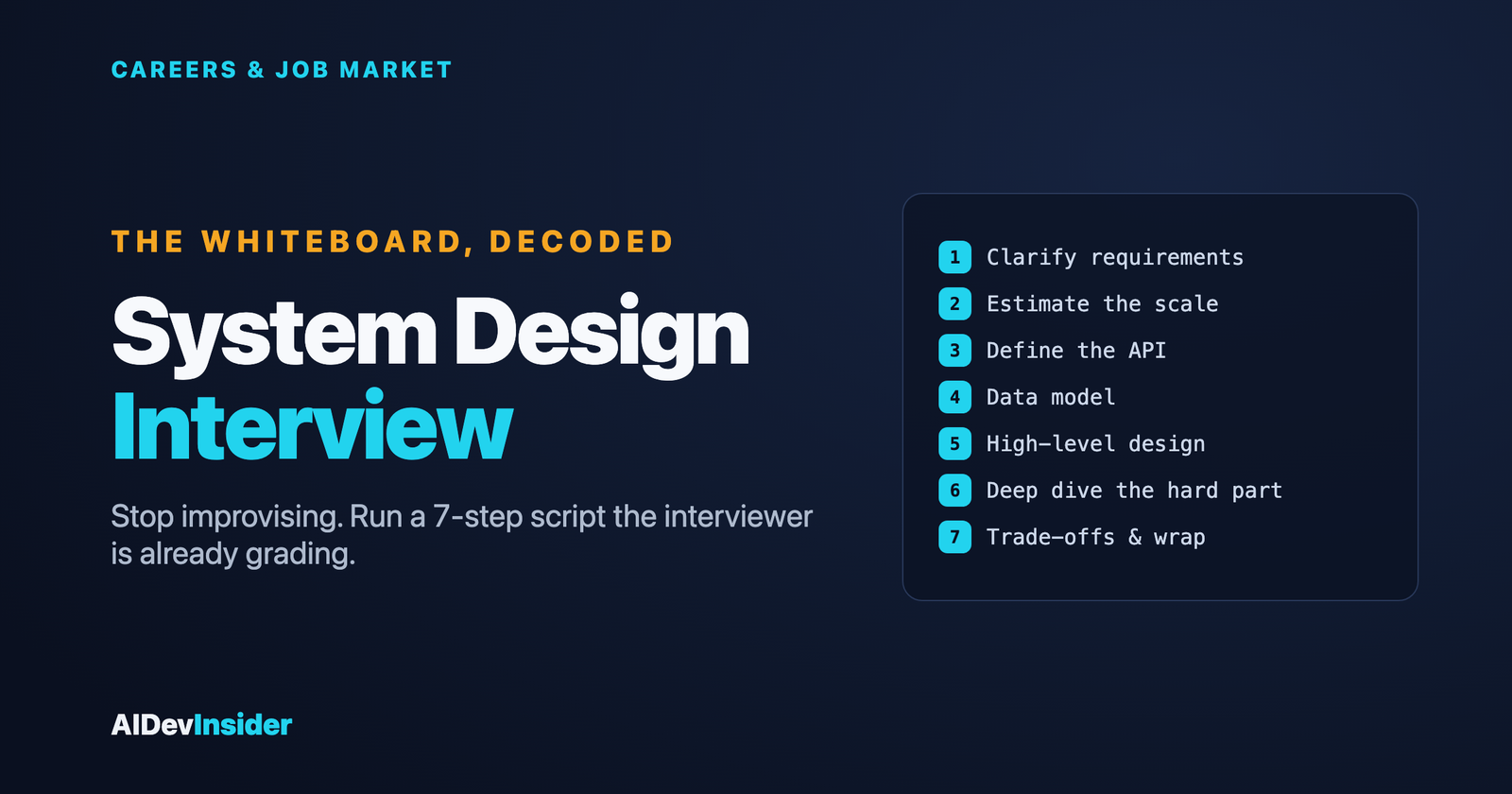
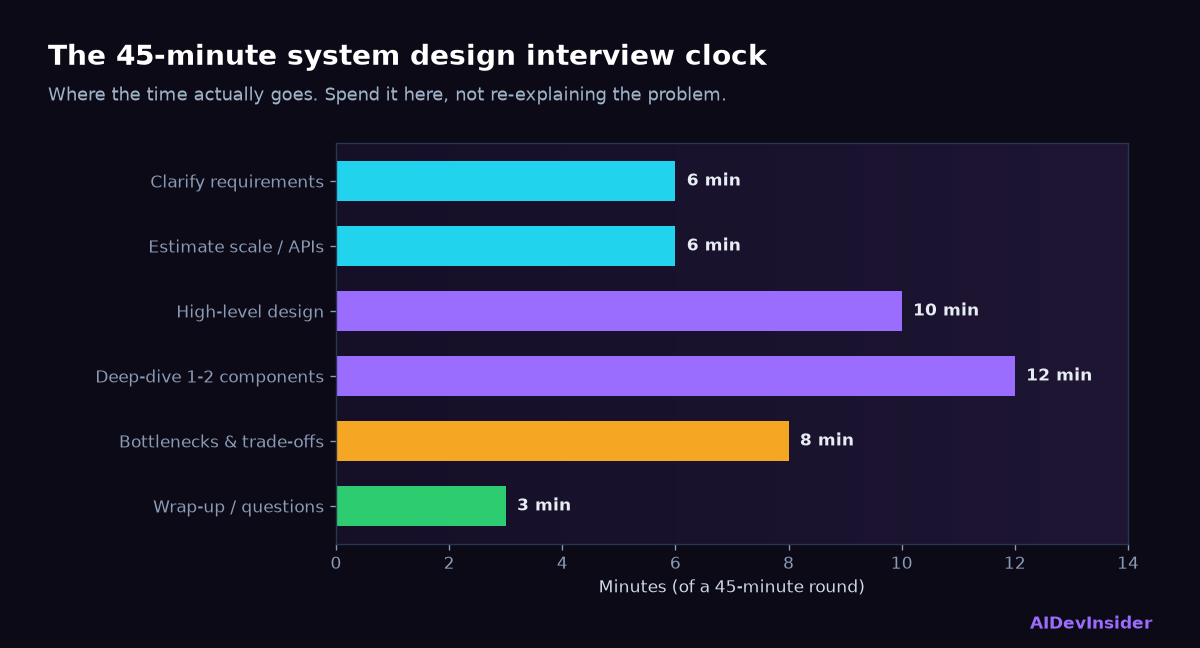
Here is the whole thing, timed for a 45-minute round so you never run out of clock on the interesting part:
| Step | Time | What you do |
|---|---|---|
| 1. Clarify requirements | ~5 min | Pin functional and non-functional scope. Ask, do not assume. |
| 2. Estimate scale | ~5 min | Back-of-envelope QPS, storage, read/write ratio |
| 3. Define the API | ~3 min | The handful of endpoints the system exposes |
| 4. Data model | ~4 min | Access patterns first, then pick the store |
| 5. High-level design | ~8 min | Clients to services to storage, boxes and arrows |
| 6. Deep dive | ~15 min | The one or two hard parts, in detail |
| 7. Trade-offs and wrap | ~5 min | Name what you chose, what you gave up, what is left |
The two mistakes that sink people are skipping steps 1 and 2 to get to the drawing, and spending all fifteen deep-dive minutes on the easy part. Guard those.
A worked system design interview: shorten a URL
Let me run the framework on the classic warm-up so the steps are concrete instead of abstract.
Step 1, clarify. I say out loud: “So we shorten a long URL to a short code, and redirect on lookup. Functional: create a short URL, resolve it. Non-functional: highly available, redirects under 100 ms, and I am assuming this is read-heavy, maybe 100 reads per write. Is that the right shape?” That last question matters. Asking, rather than assuming, is itself scored.
Step 2, estimate. This is the step that separates a pass from a stall, and it is just arithmetic:
100 M new URLs / month
  = 100,000,000 / (30 * 24 * 3600 s)
  ~= 40 writes / second        (trivial load)
Read:write = 100:1
  => ~4,000 reads / second      (peak higher, say 2x = 8,000)
Storage: 100 M/mo * 12 mo * 5 yr * ~500 bytes
  ~= 3 TB over 5 years          (small; one DB can hold it)
The math tells me the design before I draw it: writes are nothing, reads need a cache, storage fits on a single well-chosen database. I have just justified my whole architecture with three lines of long division.
Step 3, the API. Two endpoints, no more:
POST /urls        body: { "long_url": "..." }   -> { "code": "aZ3xK" }
GET  /{code}      -> 301/302 redirect to long_url
Step 4, data model. The access pattern is a key lookup by code, both ways. That points at a simple keyed store:
urls(
  code        VARCHAR(8) PRIMARY KEY,   -- base62 short code
  long_url    TEXT NOT NULL,
  created_at  TIMESTAMP,
  INDEX (long_url)                       -- dedupe identical inputs
)
Base62 (a-z, A-Z, 0-9) gives about 57 billion combinations at 6 characters, which is comfortably past our 5-year volume. I mention that so the interviewer sees the code length was a decision, not a guess.
Step 5, high-level design. Now I draw, and only now: client to a load balancer, to stateless API servers, to a database, with a Redis cache in front of the read path. The write path skips the cache. That is the whole picture, and every box on it traces back to a number from step 2.
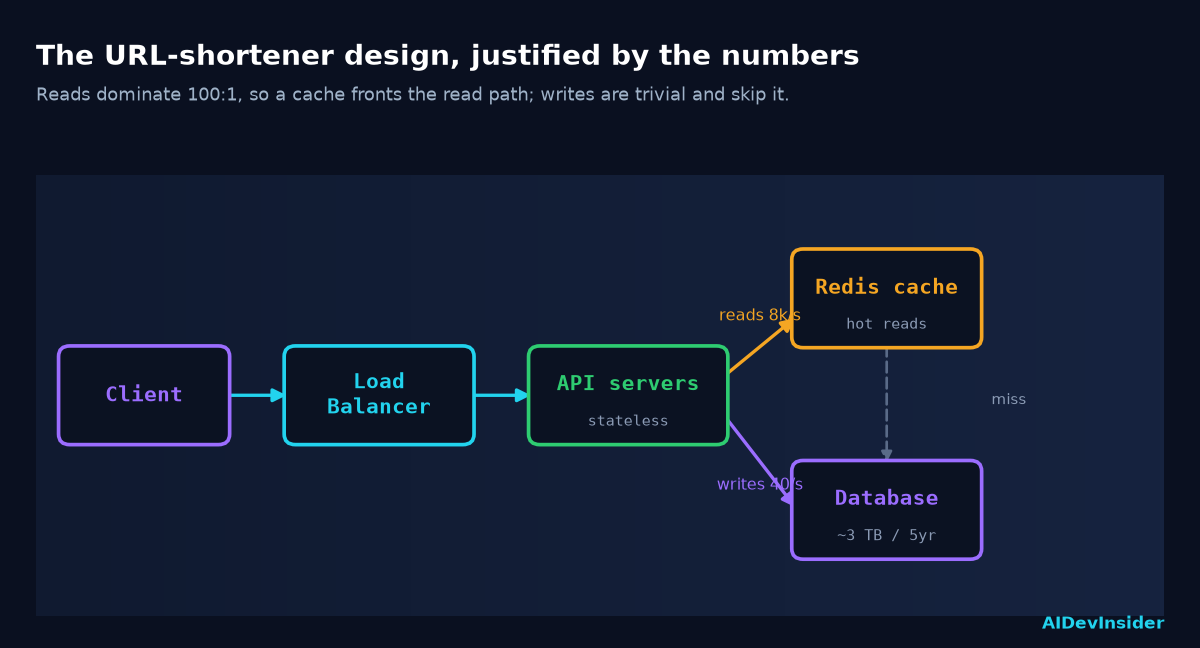
Step 6, the hard part. With reads at thousands per second, caching is the hard part worth the fifteen minutes. Short URLs follow a power law, roughly 20 percent of codes get 80 percent of the traffic, so an LRU cache keyed on the short code with a 24-hour TTL keeps the hot set resident naturally. If I cache 10 percent of URLs at 500 bytes each, that is around 60 GB, which is a reasonable Redis cluster and I say so with the number attached.
Step 7, wrap. “To recap: load-balanced stateless API servers, a relational store for persistence, Redis caching the hot read path, base62 codes, handling roughly 40 writes and up to 8,000 reads per second. What I did not cover: expiration at scale, click analytics, abuse prevention, and multi-region replication for global latency.” Naming the gaps is not weakness. It is the operational maturity the rubric rewards.
The trade-offs interviewers are actually scoring
Underneath every round is a small set of judgment calls the interviewer is quietly grading. The ones that come up almost every round:
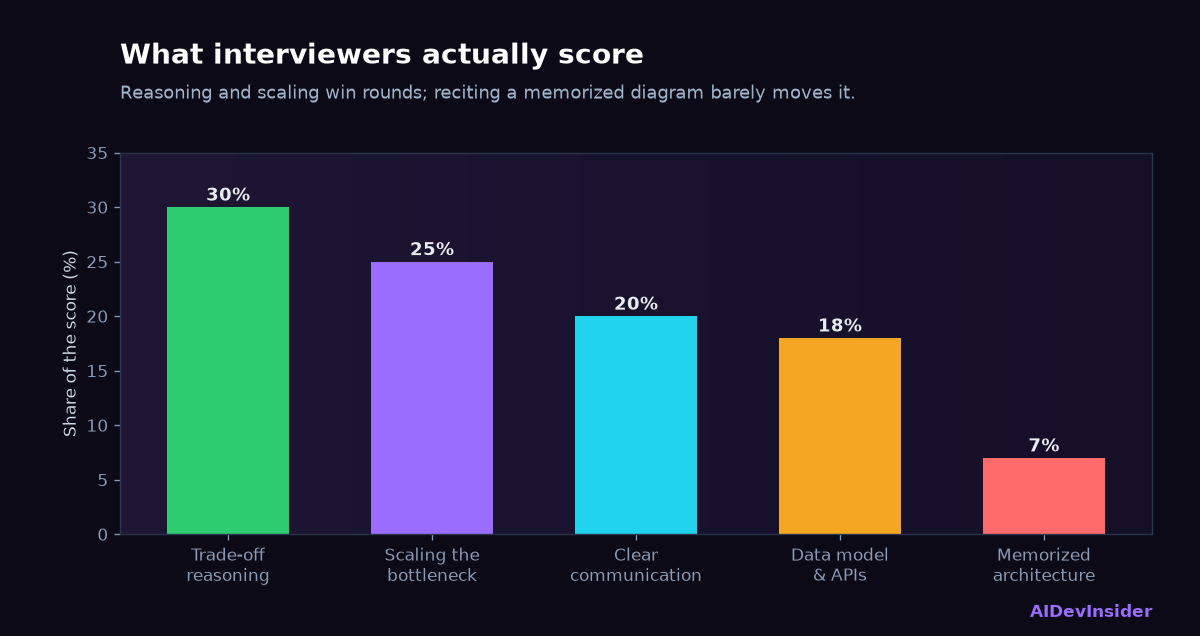
- Consistency versus availability. For a URL shortener I chose availability: a redirect served from a slightly stale cache is fine. For a payment system I would not. Say which you picked and why.
- SQL versus NoSQL. Not a religion. It follows the access pattern. A pure key lookup can go either way; I default to the store I can reason about fastest under pressure and justify it in one sentence.
- Cache invalidation. A TTL is a choice with a cost: staleness. I name the TTL and what it means if the mapping changes.
- Where the bottleneck moves. Every fix relocates the pressure. Adding a cache moves load off the DB and onto cache memory and eviction policy. Good candidates say where the next bottleneck will appear.
What a strong system design interview answer sounds like
The difference between a pass and a borderline is rarely the architecture. It is the narration. A strong candidate thinks out loud, attaches a number to every claim, asks before assuming, and treats the interviewer as a collaborator rather than an examiner. “This is read-heavy so I will cache” is fine. “This is read-heavy, roughly 8,000 reads a second at peak against 40 writes, so the read path needs a cache and the write path does not” is a hire signal. Same idea, but one of them shows the work.
How to practice so it sticks
You do not memorize solutions, you build reps with the framework. What worked for me: pick one classic problem, set a 45-minute timer, and run all seven steps out loud as if someone were watching. Rate limiter, news feed, chat app, key-value store. After each run, write down only two things: which step you rushed, and which number you could not produce fast enough. Those two notes are your whole study plan. Do eight to ten problems that way and the loop becomes muscle memory, which is the entire point, because under interview stress you fall back to what is automatic.
FAQ
What is a system design interview? A 45 to 60 minute technical interview where you design the architecture of a large-scale system, such as a URL shortener or a chat app, from a deliberately vague prompt. The interviewer scores your judgment under ambiguity, technical depth, and communication, not whether you reach one correct answer.
How do I start a system design interview without freezing? Do not draw first. Start by clarifying functional and non-functional requirements out loud, then do the back-of-envelope estimation. Those two steps produce the numbers that justify every later decision, so the architecture almost designs itself.
What do interviewers actually evaluate? Scoping an ambiguous problem, choosing appropriate components, reasoning about scale with real estimates, and naming trade-offs. Communication and structure matter as much as the final diagram.
How long should I practice? Roughly eight weeks of consistent reps is reasonable. Run eight to ten classic problems on a 45-minute timer using the same framework, and review which step you rushed each time.
Related reading: LangGraph Tutorial: 5 Proven Steps to Fix a Fragile Agent, Oracle Layoffs 2026: What 546 Cuts Reveal About Developer Jobs.
Related reading: How to jailbreak PS5: 5 proven, painful facts about Relapse.
Related reading: Python Interview Questions: 15 Proven Painful Traps Exposed.
Sources: DesignGurus system design interview guide (2026); The System Design Interview Framework, AlgoEngineer; System Design: The Complete Guide 2026, System Design Handbook. The seven-step loop and estimation approach reflect rounds I have run and sat on as an interviewer.