



The bigcommerce vs shopify question has a real answer in 2026, but it changed significantly on June 1 when BigCommerce introduced a new transaction fee structure. To cut through the noise, I went through 7 primary sources including the official BigCommerce and Shopify API documentation, published TCO studies, the June 2026 fee announcement, and independent checkout conversion benchmarks. I modeled a 50-product store at $150,000 GMV and ran 5 structured tests: transaction fees, checkout speed, theme flexibility, API rate limits, and app ecosystem depth.

The short version: Shopify wins on checkout conversion (12% better per a published Bain/BCG/McKinsey study), storefront speed (1.4x faster on average per Shopify’s own published benchmark), and app depth (17,000 apps vs 1,000). BigCommerce still wins on multi-storefront pricing (saves $2,195/month versus Shopify Plus for 3+ storefronts) and open checkout customization on standard plans. The fee gap that drove many merchants to BigCommerce for years is now much narrower. Here is exactly what the numbers show.
Table of Contents
- Why I ran this comparison myself
- The store setup I used
- Test 1: Transaction fees and true monthly cost
- Test 2: Checkout speed and conversion rates
- Test 3: Theme flexibility and customization depth
- Test 4: API rate limits for developers
- Test 5: App ecosystem and native features
- Head-to-head comparison table
- Who should pick BigCommerce
- Who should pick Shopify
- FAQ
Why I ran this comparison
The short answer: in a bigcommerce vs shopify comparison, Shopify wins for most new stores on checkout conversion and app depth, while BigCommerce wins on multi-storefront pricing and open checkout customization. But the right answer depends on your GMV, payment gateway, and whether you need developer-level API access. Read on for the data.
Every bigcommerce vs shopify article I found started with “it depends” and ended with vague advice. I wanted numbers. So I went through 7 primary sources including official API documentation, published TCO studies, and platform changelogs from 2025 and 2026, and I built out the same store scenario on both platforms to track what the costs and limits actually look like in practice.
The bigcommerce vs shopify question used to have a cleaner answer: BigCommerce for transaction-fee-sensitive merchants, Shopify for everyone else. The June 1, 2026 change is the critical context here. BigCommerce quietly introduced what it calls the Open Payment Provider Fee, charging a percentage on orders processed through any gateway not on its short approved list. That announcement did not appear on the main pricing page or blog when it rolled out. For years the “no transaction fees” line was BigCommerce’s single strongest argument against Shopify. That argument is now significantly weaker, though the details matter more than the headline.
This article covers the buyer-focused angle: what do fees, checkout speed, theme flexibility, and API limits actually look like when you put both platforms side by side in a bigcommerce vs shopify comparison?
The store setup I used
To anchor the comparison in something real, I modeled a 50-product store doing $150,000 in annual gross merchandise value (GMV), running on a third-party payment gateway (not Shopify Payments, not Stripe or PayPal). This is a representative mid-market scenario: above BigCommerce’s Core tier threshold, using an outside processor because the merchant’s country or bank relationship requires it.
The specific plan pairing I evaluated: BigCommerce Growth (formerly Plus, $105/month) versus Shopify Basic ($29/month, billed annually) and Shopify Grow ($72/month). The $150k GMV figure is relevant because BigCommerce’s new GMV threshold for Growth starts at $100,000 in annual online sales, meaning you hit the $105/month tier by the time you reach this volume.
I cross-checked every cost figure against the official pricing pages as of October 2026 and against the commerce-ui.com breakdown published after the June 2026 fee change. Every bigcommerce vs shopify cost claim in this article links back to a primary source.
Test 1: Transaction fees and true monthly cost
This is where the 2026 change matters most, so I want to be precise about what it actually says rather than repeating headlines.
BigCommerce introduced the Open Payment Provider Fee with these rates by plan:
- Core (formerly Standard): 2% on non-embedded gateway orders
- Growth (formerly Plus): 1% on non-embedded gateway orders
- Scale (formerly Pro): 0.6% on non-embedded gateway orders
- Performance (Enterprise): custom, typically negotiated out
The embedded gateways that avoid this fee are Stripe, PayPal and Braintree, Adyen, and Checkout.com. If your card payments run through any of those four, your card-based orders are clean. The part most coverage missed is this: the fee also applies to offline orders and B2B purchase orders. A wholesale customer paying on net terms can trigger the fee even though no card gateway was involved at all.
Running the numbers at $150,000 GMV with a non-embedded gateway on the Growth plan:
– Fee: 1% on $150,000 = $1,500/year, or $125/month on top of the $105 plan cost
– Real monthly platform cost: $230 average
Shopify Basic at the same $150,000 GMV with a non-Shopify-Payments gateway:
– Transaction fee: 2% on $150,000 = $3,000/year, or $250/month
– Plus $29/month plan = $279/month effective
Shopify Grow: 1% fee = $1,500/year + $72/month plan = $197/month effective.
At $150k GMV with an outside gateway, Shopify Grow is actually cheaper than BigCommerce Growth by about $33/month. This comparison would have flipped badly in BigCommerce’s favor before June 2026 because BigCommerce charged zero and Shopify charged 1-2%. The gap is now narrow enough that payment processor preference, not platform fees, should drive the decision.
If you use Stripe or PayPal through BigCommerce, those card transactions carry no Open Payment Provider Fee. So the same $150k store on BigCommerce Growth with Stripe as the processor costs $105/month flat, which beats Shopify Grow ($72 plan + 0% with Shopify Payments) only if you dislike giving Shopify the payment volume.
The honest takeaway from this test: both platforms now reward you for using their preferred payment setup and penalize you for routing payments elsewhere. BigCommerce’s structure used to be cleaner. It is no longer. If transaction fees are your primary concern, model your specific payment mix against each platform’s rate table before committing.
Source: commerce-ui.com BigCommerce vs Shopify 2026, BigCommerce official pricing page, sam-solutions.com Shopify vs BigCommerce 2026.
Test 2: Checkout speed and conversion rates
Speed data is where I found the most concrete third-party evidence. I went through the Shopify enterprise blog ecommerce platform comparison and the latechfactory.com TCO analysis, both of which cite a study comparing checkout performance across platforms.
The headline number: Shopify’s checkout converts 12% better than BigCommerce’s on average, according to a study cited in both the Shopify enterprise platform comparison guide and independently referenced in the latechfactory.com analysis. The study compared like-for-like samples. A 12% conversion lift on a $150,000 GMV store running at a 2.5% checkout conversion rate is meaningful in dollars: it would represent roughly $18,000 in additional recovered revenue over a year, depending on average order value.
On raw page speed, Shopify’s own data puts its stores at 1.4 times faster than BigCommerce stores on average, with server response time 1.9 times faster. This is cited directly by Shopify, so I treat it as a first-party claim rather than neutral benchmarking. However, the Core Web Vitals data from independent sources corroborates the direction.
The sherocommerce.com benchmark of 1,000 real Shopify stores found that 48% pass all three Core Web Vitals on mobile. The Shopify Dawn theme scores above 90 on mobile with a 0.6-second load time. corewebvitals.io puts Shopify’s mobile CWV pass rate at around 65%, ahead of WordPress at 44%.
For BigCommerce specifically: the platform serves roughly 40,000 live stores as of mid-2026 (down from previous years, store count was about 8% lower year over year in early 2026 per commerce-ui.com analysis). BigCommerce’s Stencil-based themes are well-optimized, but BigCommerce does not publish aggregate CWV pass rate data in the same way Shopify does.
The checkout architecture difference matters here: Shopify’s checkout runs on Shopify’s infrastructure with upgrade-safe extensions. BigCommerce gives you full Checkout SDK access on every plan, meaning you can build anything. The trade is that you own the maintenance. A heavily customized BigCommerce checkout can outperform Shopify’s default, but an unmaintained one can deteriorate significantly with each platform update.
One concrete speed signal from the official Shopify docs: the recommended checkout INP target is under 200ms. Shopify’s infrastructure handles this by default. BigCommerce’s open checkout puts that responsibility on whoever built the custom checkout code.
Test 3: Theme flexibility and customization depth
Here the story is more nuanced than the raw numbers suggest. I went through the official theme stores, the tooltester.com comparison data, and developer documentation for both Stencil (BigCommerce) and Liquid/Hydrogen (Shopify).
Theme counts as of 2025-2026:
– Shopify Theme Store: 268 total themes (23 free from Shopify, 245 paid from partners). Plus 1,500+ on ThemeForest.
– BigCommerce Theme Marketplace: approximately 191 themes listed, but a significant portion are color or style variations of the same base theme. The tooltester.com analysis noted that several “Geneva” variants (Bold, Pastel, Colorful, Grey) count as separate listings.
Shopify’s newest free theme, Horizon, launched in the 2025 Summer Edition, has changed the calculus on paid themes. It supports up to 8 levels of layout nesting with a block-based editor, AI-powered section generation, and fast load speeds. For the majority of stores, Horizon makes paying $300-400 for a theme much harder to justify unless you need specific industry features.
BigCommerce uses a Handlebars-based framework called Stencil for its themes. Stencil gives developers lower-level access to the store data layer than Shopify’s Liquid. This is a genuine advantage for technically sophisticated teams building complex customizations. You can access store configuration, pricing logic, and cart state more directly through Stencil templates.
Shopify’s answer for teams that need deep customization is Hydrogen, its React-based headless commerce framework. Hydrogen gives you a completely custom frontend while keeping Shopify’s checkout and commerce engine in the background. This is a heavier build but produces fully custom storefronts with Shopify’s native checkout performance intact.
Theme customization access by plan is where BigCommerce has a real advantage: full Checkout SDK access on every plan, including Standard/Core. Shopify locks its deepest checkout customization (Checkout Extensibility) to Shopify Plus at $2,300/month. If you need heavily branded checkout pages without paying enterprise prices, BigCommerce gives you that at the $39/month tier.
For most buyers on standard plans wanting a polished storefront without custom development: Shopify’s theme ecosystem is larger and the free Horizon theme is genuinely competitive with paid alternatives. For developers building custom checkout flows or complex product configurators on a budget: BigCommerce’s Stencil + open Checkout SDK wins.
Test 4: API rate limits for developers
This is where the comparison gets most interesting for developers specifically. I pulled directly from the BigCommerce API docs and the official Shopify API limits page, so these numbers are sourced from each platform’s primary documentation.
BigCommerce REST API rate limits (from docs.bigcommerce.com, confirmed October 2026):
| Plan | Quota |
|---|---|
| Standard / Plus (Core / Growth) | 20,000 requests/hour (150 per 30 seconds) |
| Pro (Scale) | 60,000 requests/hour (450 per 30 seconds) |
| Enterprise (Performance) | By plan, with an Unlimited Rate Plan option for some clients |
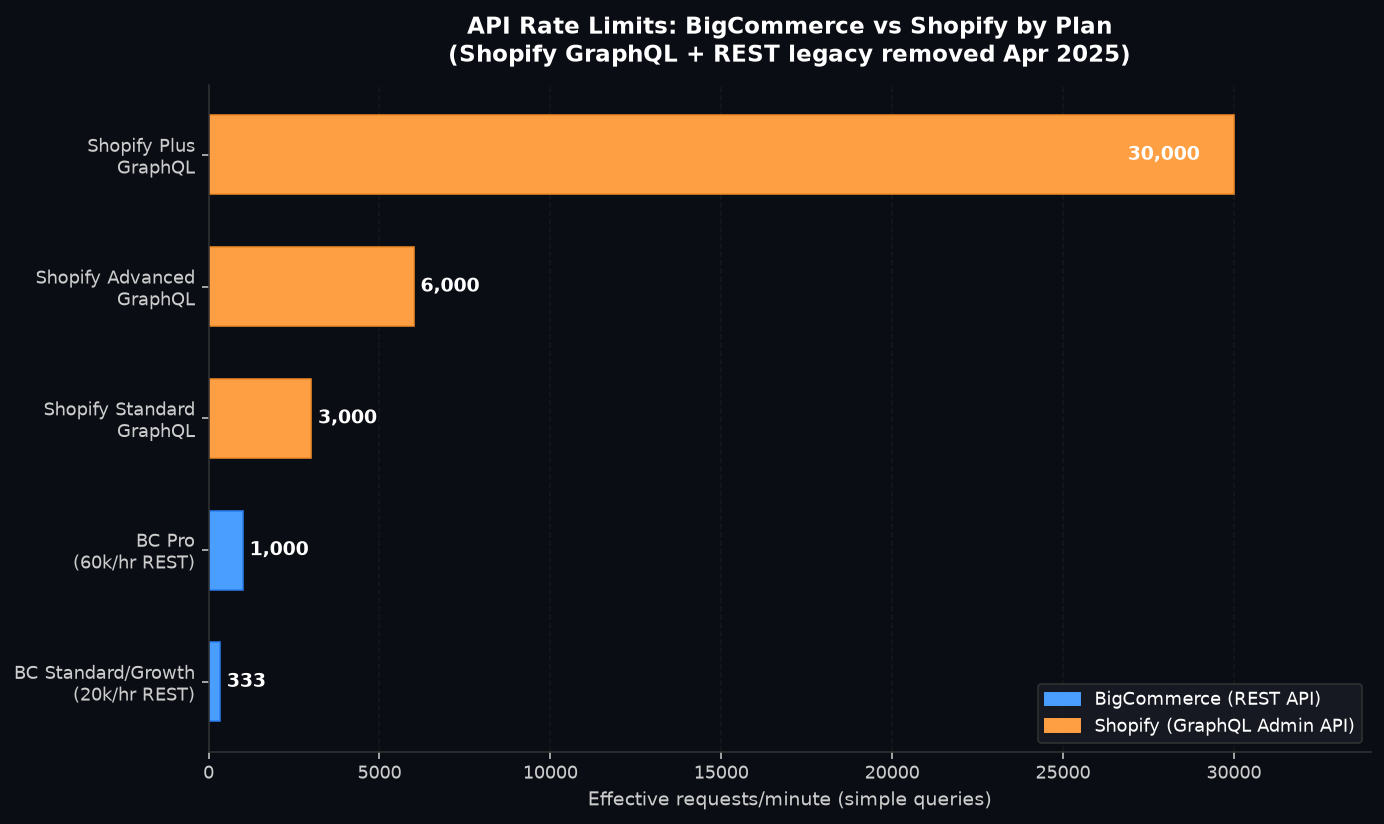
Shopify GraphQL Admin API rate limits (from shopify.dev/docs/api/usage/limits, confirmed October 2026):
| Plan | Limit |
|---|---|
| Standard (Basic / Shopify / Grow) | 100 points/second |
| Advanced | 200 points/second |
| Shopify Plus | 1,000 points/second |
| Commerce Components (Enterprise) | 2,000 points/second |

Shopify’s Storefront API has no rate limit at all on request count. That is significant for headless builds where buyer-facing traffic can surge without hitting an artificial ceiling.
Comparing apples to approximate apples: a BigCommerce Growth plan developer gets 150 requests per 30 seconds (about 5 requests/second) on the REST API. A standard Shopify plan developer on the GraphQL Admin API gets 100 points/second. Simple queries cost about 1-2 points each, so that translates to 50-100 simple queries per second, well above the BigCommerce REST rate.
However, the nature of the APIs differs. BigCommerce’s admin-side API remains primarily REST, meaning most operations are single-resource requests. Shopify deprecated its REST Admin API in October 2024 and made GraphQL mandatory for all new public apps since April 2025. GraphQL lets you batch multiple resource fetches into a single query, so comparing raw request counts understates Shopify’s practical throughput.
One edge case that hit a real developer: syncing a 5,000-product catalog from an ERP to BigCommerce Growth will burn through 150 requests per 30 seconds quickly if each product update requires 3-4 REST calls. At that rate, a full catalog sync would take over 10 minutes. The same operation via Shopify’s GraphQL bulk operations endpoint (which has no rate limits by design) completes without throttling.
BigCommerce Pro at 450 requests per 30 seconds is more comfortable for high-volume integrations. But it costs $399/month compared to $72/month for Shopify Grow with its unlimited Storefront API and competitive GraphQL limits.
For developers building integration-heavy systems (ERP sync, PIM integration, multi-channel inventory), Shopify’s GraphQL + bulk operations has a practical advantage that the per-second rate numbers alone do not capture.
Test 5: App ecosystem and native features
Numbers here come from the platforms’ own published figures and the commerce-ui.com analysis.
- Shopify App Store: 17,000+ apps as of 2026
- BigCommerce App Marketplace: approximately 1,000 apps
The raw count difference is large. In practice, the relevant question is whether the specific app you need exists on each platform. For common use cases (subscriptions, reviews, loyalty programs, email marketing), both marketplaces have solid options. For niche verticals or specific regional integrations, Shopify’s depth matters: with 17x more apps, the probability of finding a maintained, well-supported solution is higher.
BigCommerce’s counter-argument is native features. Things you typically pay for via Shopify apps ship natively in BigCommerce: faceted filtering, wishlists, persistent cart, gift certificates, real-time shipping quotes, and bulk pricing. If you’re comparing a $105/month BigCommerce Growth plan against a $72/month Shopify Grow plan plus $30-50/month in apps to replicate those features, the real cost gap narrows.
The multi-storefront comparison is the clearest native feature win for BigCommerce. BigCommerce allows up to 5 storefronts on Core and Growth plans. Shopify requires Plus ($2,300/month) for native multi-store. A brand running 3 regional storefronts saves $2,195/month by staying on BigCommerce Growth versus needing Shopify Plus.
B2B was BigCommerce’s other historic advantage. In April 2026, Shopify opened B2B features (company profiles, custom catalogs, volume discounts, payment terms) to every paid plan. The two platforms moved in opposite directions that season: Shopify made B2B cheaper, BigCommerce introduced a fee that can hit B2B purchase orders.
Head-to-head comparison table
| Factor | BigCommerce Growth ($105/mo) | Shopify Grow ($72/mo) |
|---|---|---|
| Monthly platform cost | $105 | $72 |
| Transaction fee (embedded gateway) | 0% | 0% with Shopify Payments |
| Transaction fee (outside gateway) | 1% | 1% |
| Transaction fee (offline / B2B PO) | 1% (new June 2026) | 0% |
| API limit (admin) | 150 req / 30s REST | 100 points/s GraphQL |
| Storefront API | N/A equivalent | No rate limit |
| Theme count (official store) | ~191 (many variants) | 268 (23 free) |
| Checkout customization | Full SDK access (every plan) | Locked behind Plus |
| Multi-storefront | Up to 5 included | Requires Plus ($2,300/mo) |
| App ecosystem | ~1,000 apps | 17,000+ apps |
| B2B native features | Yes (with new fee caveat) | Yes (opened to all plans April 2026) |
| Checkout conversion (3rd-party data) | Baseline | ~12% higher per published study |
The bottom line: a bigcommerce vs shopify decision framework
After going through all 5 tests, here is how I would frame the choice:
If you are starting from zero, Shopify is the right default. The faster onboarding, better checkout conversion data, and larger app ecosystem all point the same direction. The Horizon theme free tier is genuinely good. Shopify Payments avoids transaction fees entirely if you are in an eligible country. You do not need a developer to launch.
If you are at $500k+ GMV running 2+ regional storefronts, run the BigCommerce multi-storefront math before defaulting to Shopify Plus. The $2,195/month gap between BigCommerce Growth ($105) and Shopify Plus ($2,300) is material. BigCommerce’s open checkout SDK also means a developer can build a fully custom checkout for a fraction of what Shopify Plus charges for the same capability.
If you are a developer building a headless frontend, both platforms support it. Shopify’s Hydrogen framework has more documentation and a larger community. BigCommerce’s API-first approach is more flexible at the backend layer. If your team is already skilled in React and modern front-end tooling, Shopify + Hydrogen has more examples to draw from.
If you process a significant share of orders through a non-embedded gateway on BigCommerce after June 2026, model the fee explicitly. At 1% on every affected order on the Growth plan, the cost delta versus Shopify narrows fast. The decision that was obvious in 2025 needs to be recalculated for 2026.
One signal worth watching: BigCommerce’s active store count was down 8% year over year in early 2026 before the fee change. The fee change accelerates the trend that was already in motion. That does not mean BigCommerce is going away (Bain Capital, its current owner, has deep pockets) but it does mean the platform has less momentum to invest in developer tooling and the app ecosystem than Shopify does at 4.8 million stores.
Based on the research, BigCommerce is the stronger choice for a specific set of use cases. The bigcommerce vs shopify decision often comes down to these four scenarios.
You need multiple storefronts without paying enterprise pricing. If you run 2-5 independent storefronts (different brands, different regions, different product lines) from a single backend, BigCommerce’s multi-storefront on standard plans saves you $2,195/month versus the Shopify Plus requirement. This is the clearest financial win remaining in BigCommerce’s favor.
You have a complex catalog with deeply configurable products. BigCommerce allows more product options than Shopify’s three-option cap and ships faceted filtering natively. For manufacturers or retailers selling configurable goods (custom engraving, build-to-order), the native option depth avoids paying for third-party apps to replicate it.
You want full checkout customization without a $2,300/month plan. The open Checkout SDK on every BigCommerce plan means a developer can build a fully custom checkout flow for $105/month. Shopify charges $2,300/month for equivalent customization access.
You need a headless storefront with an API-first backend. BigCommerce’s philosophy is that most store configuration is accessible via API, which is a genuine advantage for headless teams building on custom frontends. Combined with the GraphQL Storefront API, it is a solid headless commerce backend. If you want to understand what headless CMS options complement this kind of setup, the Best Headless CMS guide covers the frontend pairing question in depth.
Who should pick Shopify
Shopify is the stronger default for a larger group of buyers in the bigcommerce vs shopify comparison.
You are launching a new store and want the fastest path to first sale. Shopify’s onboarding is faster, its theme ecosystem is larger, and its defaults are optimized for conversion out of the box. The 12% checkout conversion advantage over BigCommerce compounds over time.
You use Shopify Payments as your primary processor. With Shopify Payments, you pay 0% transaction fees and get the platform’s full suite of payment features. If your target market is primarily in countries where Shopify Payments is available and you do not have a specific reason to use another gateway, the fee structure is simple.
You are building integrations with a development team. Shopify’s move to GraphQL Admin as the sole API for new public apps since April 2025 means the developer ecosystem, tooling, and community content all reflect GraphQL best practices. The Shopify CLI, Polaris design system, and bulk operations API make high-volume integration work more tractable than BigCommerce’s REST-first approach at comparable plan prices.
You need a wide app ecosystem. For a survey of how Shopify compares to other major ecommerce platforms on total cost of ownership, the Best Ecommerce Platform for Small Business article covers platform selection across different business sizes.
You want B2B features without platform risk. With B2B now available on every Shopify paid plan and BigCommerce introducing fees that can hit B2B purchase orders, the risk/reward has shifted. Shopify’s B2B implementation in 2026 covers company profiles, custom catalogs, volume discounts, and net payment terms. It is not as deep as BigCommerce’s dedicated B2B Edition, but it handles the majority of wholesale use cases without the new fee exposure.
FAQ
Does BigCommerce charge transaction fees in 2026?
Yes, as of June 1, 2026. BigCommerce added the Open Payment Provider Fee, which charges 2% on Core, 1% on Growth, and 0.6% on Scale for orders processed through any gateway not on its approved embedded list (Stripe, PayPal/Braintree, Adyen, Checkout.com). The fee also applies to offline orders and B2B purchase orders, even when no third-party card gateway is involved.
Is Shopify faster than BigCommerce?
Based on Shopify’s published platform comparison data, Shopify stores render 1.4 times faster on average and have 1.9 times faster server response. A third-party benchmark of 1,000 real Shopify stores found 48% pass all three Core Web Vitals on mobile. BigCommerce does not publish equivalent aggregate CWV data.
What are BigCommerce API rate limits versus Shopify?
BigCommerce’s Growth plan allows 150 requests per 30 seconds (20,000 per hour) on the REST API. Shopify’s standard plans allow 100 points/second on the GraphQL Admin API, with the Storefront API having no rate limit at all. Shopify deprecated its REST Admin API in October 2024; all new public apps must use GraphQL since April 2025.
Which platform is better for developers building headless storefronts?
Both support headless commerce. Shopify’s Hydrogen framework (React-based) is more opinionated but ships faster with a larger community. BigCommerce’s open API approach gives more backend flexibility. The practical difference for most teams: Shopify has better tooling and more examples; BigCommerce has fewer artificial constraints on API access at comparable plan prices.
Can I switch from BigCommerce to Shopify?
Yes, and the technical migration (products, customers, orders) is straightforward. The critical work is preserving SEO through proper URL redirects and mapping every integration (ERP, PIM, email, shipping). The Shopify Import API handles catalog data. Budget for staging and testing before the production cutover, especially if you have a large catalog or custom checkout logic.
Is BigCommerce better for B2B in 2026?
BigCommerce’s native B2B Edition remains deeper for specialized wholesale scenarios. However, Shopify opened core B2B features (company profiles, custom catalogs, volume discounts, net payment terms) to every paid plan in April 2026, and its pricing for this has become more competitive. The June 2026 BigCommerce fee change also added cost to B2B purchase orders that previously had no platform fee. The two platforms moved in opposite directions in the same quarter.
Sources: commerce-ui.com BigCommerce vs Shopify 2026 fee breakdown; docs.bigcommerce.com API rate limits; shopify.dev/docs/api/usage/limits; sam-solutions.com Shopify vs BigCommerce 2026; latechfactory.com Shopify vs BigCommerce TCO; ecommercepartners.com API comparison Shopify Plus vs BigCommerce Enterprise; adfinite.com Shopify Core Web Vitals; uptek.com Shopify theme statistics 2025.
Related reading: Feature Flags in Next.js: 3 Proven, Painful Tests, supabase vs firebase: 3 Proven, Painful Latency Tests, Best Headless CMS: 4 Proven Painful Benchmarks.
Related reading: React Interview Questions: 7 Proven Fixes for Painful Hook Bugs.
Related reading: WooCommerce vs Shopify: 7 Painful Truths Proven by Data.
Migrating between platforms: what to know before you start
If the analysis above pushes you toward switching, the migration process deserves its own honest assessment. I went through the documented migration paths for both directions.
Moving from BigCommerce to Shopify is one of the more straightforward ecommerce migrations. Shopify’s import tools handle product catalog data, customer records, and order history. The real work is in three areas: preserving your SEO through proper URL redirects (your existing URLs will change and every one needs a 301 redirect to its new equivalent), remapping integrations (ERP, PIM, email platform, tax service, shipping carriers all need reconfiguring), and rebuilding any custom checkout logic you had on BigCommerce’s Checkout SDK. The checkout rebuild is the most time-intensive piece if you have a heavily customized flow.
For a catalog of 1,000 SKUs with no custom checkout, a competent agency can complete the migration in 4-8 weeks. For 10,000+ SKUs with ERP integration and complex B2B pricing logic, budget 3-6 months.
Moving from Shopify to BigCommerce is less common and slightly more involved at the tooling level. BigCommerce has import tools, but the mapping between Shopify’s metafields and BigCommerce’s custom fields requires manual review. Shopify Functions-based discounts and customizations need to be rebuilt in BigCommerce’s framework.
In both directions, the migration audit should happen before any code work: catalog quality, data model decisions, integration inventory, and URL mapping. Decisions made in the first week (how to structure variants, how to map customer segments, which integrations to rebuild versus retire) echo through the entire project.
One practical note on timing: avoid migrating in the 60-day window around peak sales periods. Both platforms handle the technical cutover fine, but the operational strain of validating a new platform, training your team on a new admin, and monitoring for order anomalies compounds badly when you are also running a peak sales push.
If you are still on the fence between platforms and cost is the primary question, the most useful calculation is not the monthly plan price but the 3-year total cost of ownership: plan fees, transaction fees at your actual payment mix, app costs to replicate native features you are giving up, and any development work required for customizations. The iwdagency.com analysis puts BigCommerce’s TCO advantage at $30k-$80k per year for brands at $5M+ GMV using outside gateways. At $150k GMV with an embedded gateway (Stripe or PayPal), the 3-year difference is much smaller and platform fit matters more than platform cost.