


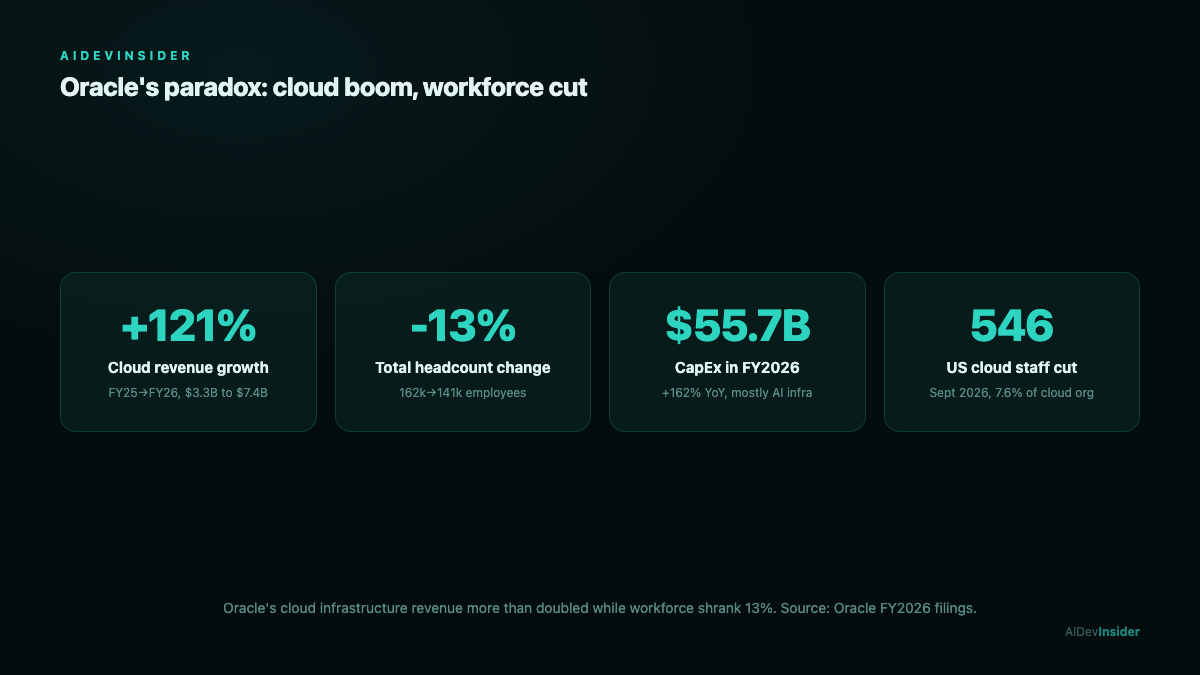
The Oracle layoffs 2026 story is confusing on the surface: Oracle’s cloud infrastructure business is booming, with revenue up 121% year-on-year to $7.4 billion, and the company is pouring $90 to $95 billion into AI data centers. By every growth metric, Oracle Cloud is winning. And yet it just cut some of the very engineers who built that cloud.
That contradiction is the whole point, and it is why the Oracle layoffs 2026 data is worth reading carefully rather than as just another layoff headline. 546 cloud infrastructure workers in the US were handed termination notices in September 2026, about 7.6% of Oracle’s Americas Cloud Infrastructure organization, per an internal document Oracle filed to comply with US age-discrimination law. The same wave has reached India, where estimates from inside the company put the potential impact at 1,000 to 3,000 employees, concentrated in Bangalore and Hyderabad.
The Oracle layoffs 2026 story is not a struggling-company story. It is a structural one about where developer work is heading in the AI infrastructure era, and it applies far beyond Oracle.
Table of Contents
What the Oracle layoffs 2026 data actually shows
A breakdown of the 546 US cuts, obtained by Business Insider from Oracle’s WARN Act filing, reveals which roles are being eliminated. Unlike a vague corporate statement, a WARN filing is a legal document with real numbers, which makes it one of the clearest windows we have into how an AI-era layoff is actually distributed.
- Software Developer III was the single hardest-hit title: 57 departures, roughly 17% of all cuts when you add up developer levels across the org.
- Program managers accounted for 61 departures. Total positions with “manager” in the title: 128, nearly one-quarter of all layoffs.
- Principal core infrastructure engineers were heavily affected, as was Oracle’s data center support services unit, which lost 41 staff, including a vice president and two senior directors.
The age profile is notable too. Most of those laid off in the Oracle layoffs 2026 round were over 40. About one in six was 60 or older. Oracle disclosed the data precisely because US federal law requires it when a layoff could be construed as targeting older workers.
In India, People Matters reported that layoffs started in the US on September 14 before extending to India, with product engineering teams taking the most damage. Support and consulting functions saw relatively limited impact, for now.
The 546 cuts, broken down by role
When you visualize which roles absorbed the cuts, a pattern jumps out immediately: the Oracle layoffs 2026 losses cluster around coordination work and routine infrastructure, not the specialized technical roles Oracle is racing to fill.
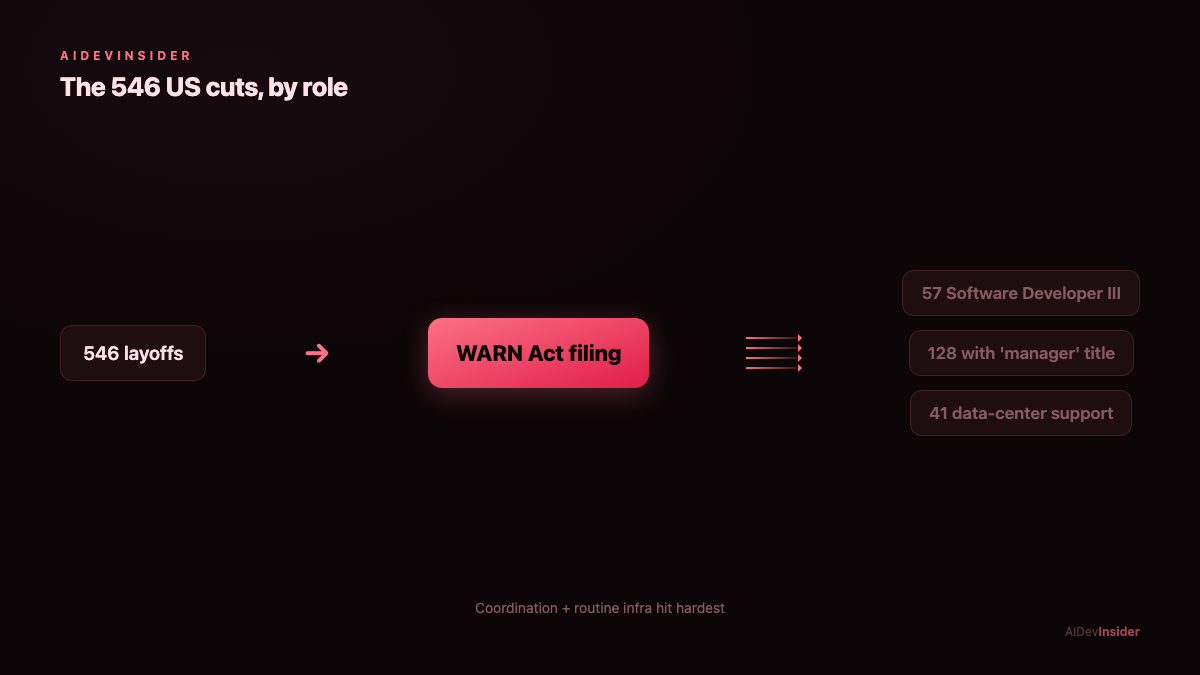
Two things are worth sitting with here. First, the concentration in “manager” titles is not an accident of one org chart; it is a deliberate flattening. Second, the fact that principal engineers and senior directors appear at all tells you seniority is not protection when the underlying work is being automated or wound down. We will come back to both, because they are the most transferable lessons from the Oracle layoffs 2026 for your own career.
The numbers that explain everything
Oracle’s financial filings tell the real story behind the cuts:
| Metric | FY2025 | FY2026 |
|---|---|---|
| Total headcount | 162,000 | 141,000 (-13%) |
| Cloud infra revenue | ~$3.3B | $7.4B (+121%) |
| Capital expenditure | ~$21B | $55.7B (+162%) |
| Free cash flow | Positive | -$23.7B |
| Restructuring costs | $374M | $1.8-2.8B |
Source: Oracle FY2026 annual filing via CNBC
Oracle shed 21,000 jobs, 13% of its entire global workforce, in a single fiscal year, while simultaneously tripling capital expenditure. The company took on roughly $50 billion in debt and equity to fund AI data center construction. The trade-off is explicit: Oracle borrowed against its future to fund the infrastructure race, and human headcount is one of the expenses being compressed to make the cash flows work.
CEO Larry Ellison has been vocal about what that infrastructure is for: training and running large language models for enterprise customers. Oracle’s GPU clusters, many running NVIDIA H100s and B200s, are now among the most sought-after in the market.
The irony is precise. Oracle built its empire selling database software that ran on servers managed by humans. Now it is spending tens of billions to build infrastructure that needs far fewer humans per unit of compute. Negative free cash flow of $23.7 billion is not a sign of distress here; it is the financial signature of a company front-loading enormous capital spending and expecting the automation it buys to lower operating headcount for years.
India: routine roles shrink, GCC hiring grows
For Indian developers, the Oracle layoffs 2026 picture is more nuanced than the headline suggests, and getting this nuance right matters because India carries a disproportionate share of the Oracle layoffs 2026 impact.
Oracle India employs roughly 30,000 people. The current round of cuts could take that number to 27,000, a 10% reduction. Bangalore’s engineering centers, which house large product engineering teams, are feeling it most. The “6 AM email,” which became grim shorthand for Oracle’s March 2026 US layoffs, is now the thing engineers in Koramangala and Whitefield are bracing for again.
But at the same time, Times of India reported that Global Capability Center (GCC) hiring is set to grow 9 to 10% in this cycle. This is not contradictory. It reflects a deliberate separation that Indian tech is experiencing across the board:
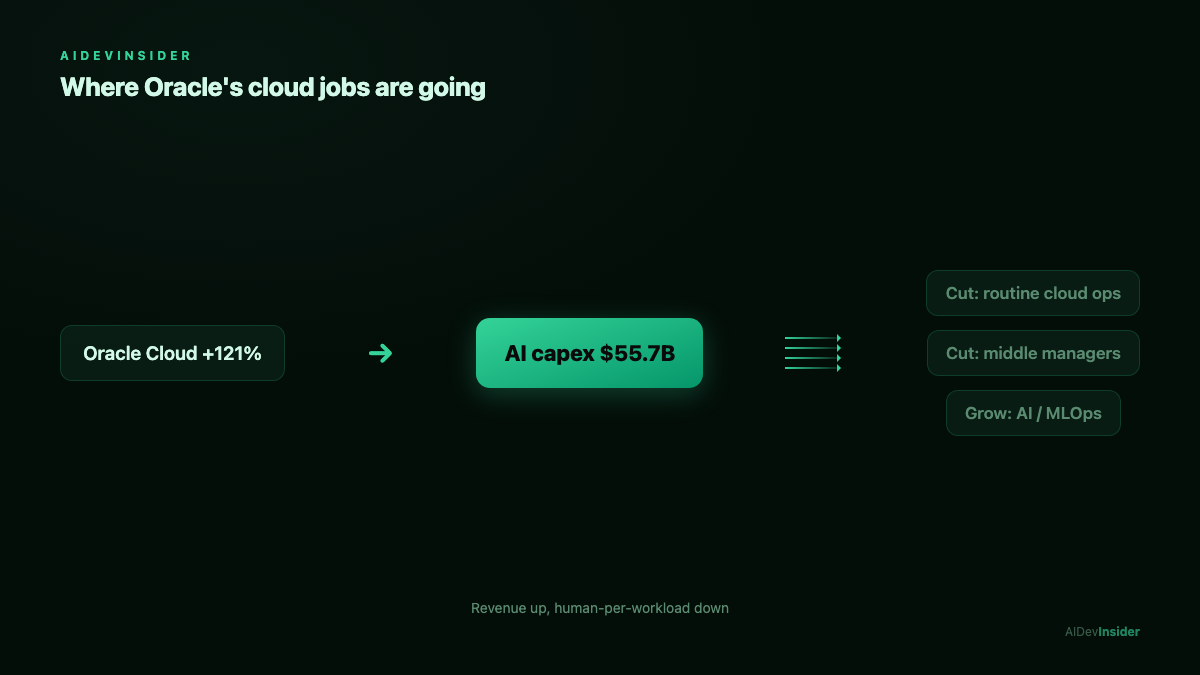
- Routine cloud ops and infra support: Under pressure. Automation and AI tooling (observability platforms, self-healing infrastructure, AI-assisted incident response) are replacing the tier-1 and tier-2 work that employed large teams.
- AI and ML engineering, GPU cluster management, LLMOps, distributed systems design: Growing. The GCCs that are expanding are specifically hiring for these skills.
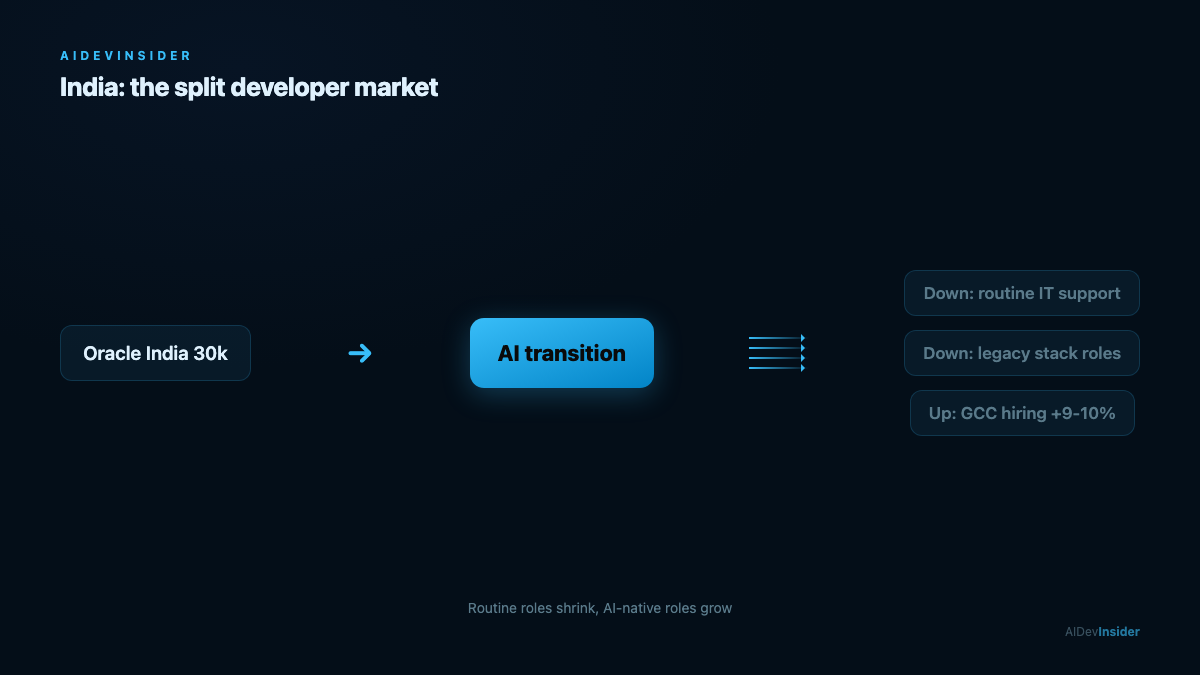
Oracle’s own AI push (OCI Generative AI, Oracle Database 23ai, Autonomous Database) requires engineers who can work at the intersection of cloud and AI. That talent profile is different from the software developer who managed classic Oracle Cloud deployments. If you are an Indian developer reading the Oracle layoffs 2026 news with anxiety, the actionable takeaway is not “tech is collapsing,” it is “the demand has moved to a specific adjacent skill set, and the move is happening fast.”
What this means if you’re a developer
The Oracle layoffs 2026 data is a specific, well-documented example of a pattern showing up across the 2026 tech industry: cloud revenue is growing, but the human-per-workload ratio is falling fast. A few things are clearly visible in the data.
Program managers are being hit disproportionately. 128 of 546 cuts at Oracle had “manager” in the title. This echoes similar patterns at Google (which cut several layers of middle management in 2025), Meta, and Microsoft. AI tools are making it easier to track project status, generate reports, and coordinate across teams without a dedicated human PM layer. If your role is primarily coordination and status aggregation, that is a real risk.
Infrastructure engineers doing repetitive operational work are vulnerable. The 41 cuts in Oracle’s data center support services unit, including senior directors, suggest it is not just junior roles. The work of managing physical infrastructure at scale is increasingly automated. Hyperscalers are building AI-powered operations platforms that reduce human intervention in routine monitoring, provisioning, and incident response.
Senior technical roles are not safe from the math. Principal engineers and senior managers were in the list. When a company needs to move fast on capex, it cuts seniority levels that carry higher compensation costs, especially if their work is in a part of the business that is shrinking (legacy Oracle products) rather than growing (OCI AI).
The age skew matters. The majority of Oracle’s cut employees were over 40. This is consistent with a 2026 pattern of older engineers, who built expertise on Java, PL/SQL, and the legacy Oracle stack, being retrained for AI-native workflows less often than younger engineers who picked up Python, PyTorch, and cloud-native tooling from the start. It is not that experience stopped mattering; it is that experience in a contracting technology stopped protecting the role.
What is holding up in the market: distributed systems design, GPU infrastructure management, MLOps, LLM fine-tuning pipelines, AI security and observability, and anything that requires systems thinking applied to AI workloads. These are roles Oracle and its competitors are actively trying to fill even as they cut elsewhere.
How to position yourself on the right side of this
Reading layoff data is only useful if it changes what you do next. Here is how to translate the Oracle layoffs 2026 signal into concrete moves, whether you are inside a company like Oracle or watching from a smaller team.
Audit whether your daily work is “coordination” or “creation.” The clearest lesson from the manager-heavy cuts is that roles which mostly move information between people are the first to be compressed by AI tooling. If most of your week is status updates, ticket triage, and handoffs, deliberately move a chunk of it toward work that produces an artifact only you can produce: a system design, a performance fix, a piece of infrastructure automation.
Get hands-on with the AI stack you are adjacent to. You do not need to become a research scientist. The GCC roles that are growing want engineers who can run and operate AI systems: standing up inference endpoints, managing GPU scheduling, building retrieval pipelines, and wiring observability around model behavior. If you already know cloud infrastructure, this is a lateral step, not a career restart.
Learn where model routing and cost control actually happen. A large share of real-world AI engineering is unglamorous plumbing: routing requests across providers, controlling spend, and failing over when something breaks. We covered exactly this in our piece on what an LLM gateway actually does for a coding agent, and it is a good on-ramp for infrastructure engineers moving toward AI work.
Treat autonomy tooling with the same rigor you’d want your employer to. As teams get leaner, more work is handed to coding agents, and the failure modes get expensive. Our write-up on how a coding agent’s permissions can prevent disasters is a concrete example of the operational judgment that stays valuable no matter how much gets automated.
For more on how the tech job market is shifting, our ongoing Careers & Job Market coverage tracks these transitions across companies, not just Oracle.
A concrete 90-day plan. If you want a structured way to act on the Oracle layoffs 2026 signal rather than vague anxiety, here is a plan we would actually follow. In the first month, pick one AI-infrastructure skill adjacent to what you already do and build one real, deployable artifact with it: a small retrieval-augmented service if you are a backend engineer, a GPU-scheduled batch inference job if you are an infra engineer, or an observability dashboard for model latency and cost if you come from an ops background.
In the second month, put that artifact somewhere public with a written explanation of the trade-offs you made, because in a leaner market the engineers who get hired are the ones who can show judgment, not just completion. In the third month, use it as the basis for internal transfer conversations or external interviews, targeting the GCC and AI-platform roles that are actively growing.
What not to do. Do not try to become an AI researcher overnight, and do not chase every new model release. The roles that survived the cuts were not held by people who knew the most trivia about transformers; they were held by people who could keep real systems running reliably. Depth in operating AI systems beats breadth of headlines. The engineers who treated the last decade’s cloud transition as a reason to learn how cloud actually worked, rather than to panic, are the same profile who will do well now.
Watch the leading indicators, not the layoff headlines. By the time a cut is announced it is already too late to react. The useful signals are earlier: which internal teams are getting headcount, which job postings your employer keeps re-opening, and where the capital expenditure is going. Oracle’s own capex line told this story a full year before the September cuts landed.
The bigger picture across 2026 tech
Oracle is not alone. According to CNBC’s reporting on Oracle’s June annual filing, “Oracle joins several tech giants, including Meta, Google, Microsoft” in this pattern. The 2026 tech job market is split: AI infrastructure is in a capital spending boom that has no precedent, and the humans needed to run the resulting systems are fewer than the humans who built the previous generation.
Oracle’s own statement in its SEC filing is candid: “The adoption and deployment of AI technologies across our operations have resulted, and may continue to result, in reductions to our workforce.” That is a company telling its shareholders, in legally reviewed language, that automation is directly replacing labor.
This is not a cover story for a bad business. Oracle’s stock performance and revenue trajectory tell a different story. This is a company explicitly saying: AI is doing work that humans used to do, and we expect that to continue.
The question for developers, particularly in India where hundreds of thousands of careers were built on Oracle’s enterprise stack, is whether the skills you have are in the expanding part or the contracting part of this transition. Based on the data from Oracle’s own cuts, the contracting part looks like routine cloud operations, multi-layer project management, and legacy infrastructure support. The expanding part looks like AI infrastructure engineering, LLMOps, and distributed systems work on GPU-accelerated compute.
Oracle just spent $55.7 billion to tell you where the work is going. The Oracle layoffs 2026 data tells you what it is leaving behind. The engineers who come out of this cycle ahead will be the ones who read both halves of that sentence and moved toward the first.
Frequently asked questions
How many people did the Oracle layoffs 2026 affect? The September 2026 round cut 546 cloud infrastructure workers in the US (about 7.6% of the Americas Cloud Infrastructure org), part of a broader reduction of roughly 21,000 jobs, 13% of Oracle’s global workforce, across FY2026. In India, estimates put the impact at 1,000 to 3,000 employees.
Why is Oracle cutting jobs while cloud revenue is growing? Oracle is spending $55.7 billion on AI data centers and automating operational work. Cloud revenue rose 121% while the number of humans needed per workload fell, so the company is compressing headcount even as the business grows.
Which roles are most at risk? Routine cloud operations, multi-layer project and program management, and legacy infrastructure support. Roles that are growing include AI/ML engineering, GPU cluster management, LLMOps, and distributed systems design.
What does this mean for Indian developers specifically? Oracle India may shrink from about 30,000 to 27,000 staff, but GCC hiring is projected to grow 9 to 10% for AI-native skills. The Indian market is splitting: routine roles down, AI-infrastructure roles up.
Sources: Indian Express, Ctech/Business Insider, CNBC, SaaSRise, Times of India, Deccan Herald, People Matters